Fat grafting is a long established technique in cosmetic surgery; probably for as long as liposuction has been available. And that’s since the later part of the 1980s.
What’s new is that we can now select the smallest particles of fat cells (Nanofat), and use them to erase lines and wrinkles, as well as to improve skin quality. Some researchers have referred to them as stem-cell-like fractions called Stromal Vascular Fraction (SVF) or Mesenchymal Stem Cells (MSCs).
1. WHAT IS NANOFAT GRAFTING?
Nanofat injection is a method to reduce fine lines and wrinkles, or generally to improve skin quality in the face.
Nanofat is delivered like a filler injection except in this case the material used is autologous fat (one’s own fat cells).
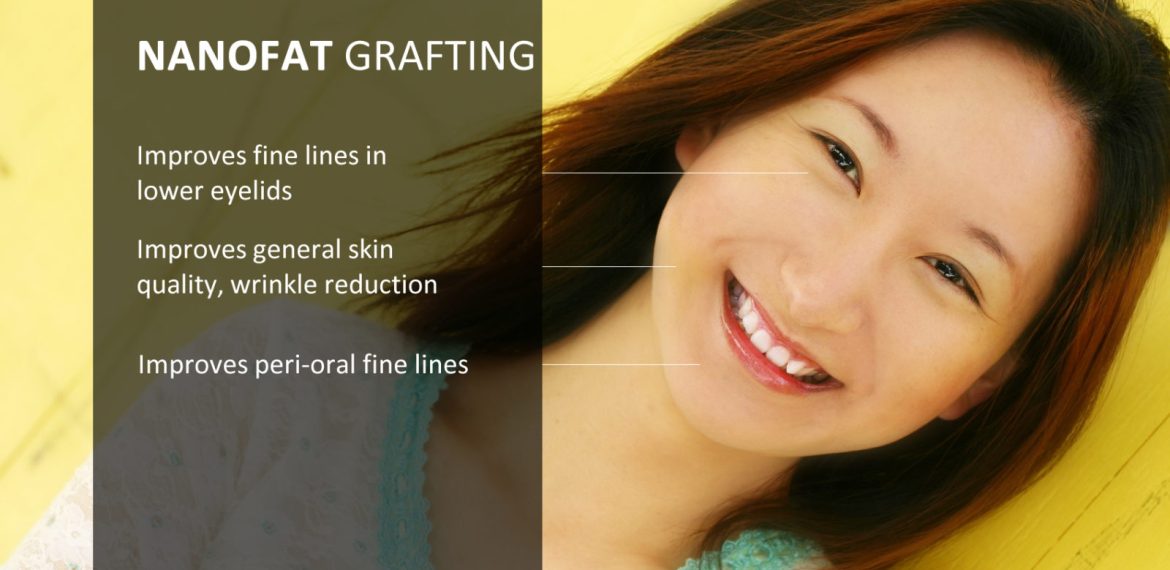
Fat grafting (or fat transfers) are not exactly a new procedure. The procedure where grafted fat is used to volumize and lift the face, has been around for a long time. Of course, techniques and methods have improved over time. However, the advent of Nanofat represents a quantum leap in Fat Grafting methods. We are now able to treat even the fine lines under the eyes and around the mouth using Nanofat delivered with a very fine cannula.
Nanofats are actually the smallest particles of fat cells, which will survive best in a transplant scenario. The skin benefits are believed to be at least partially due to the stem-cells and growth factors in the Nanofat.
The ability to micronize fat cells down to very fine spheres has opened up many new possibilities, and as such the field of fat grafting has re-gained in popularity in the last few years.
2. WHAT IS NANOFAT USED FOR?
Nanofat can deliver skin quality improvements like the reduction of fine lines and wrinkles.
Recent studies have also shown that nanofat can improve the appearance of old scars(reference article – click here). (Updated in 2021 in The Plastic Reconstructive Journal: Adipose-derived stromal vascular fraction, or more commonly referred to as Nanofat, can improve skin quality via increased collagen production, and resist UV induced skin damage when injected into the dermis of the skin.
Used together with MilliFat and MicroFat, which provide structural support for the sagging face, we can reverse a host of the signs related to ageing. The only thing it does not treat is pigmentation. But it can even reverse skin damage due to sun (or UV) exposure.
Fat grafting is often used to enhance the effects of a threadlift or some non-surgical facelift like Ultherapy and Thermage.
3. WHAT IS THE FAT GRAFTING PROCEDURE LIKE?
The procedure involves harvesting fat from the abdomen or the inner thighs under local anaesthetic – essentially a mini-liposuction.
The fat is then cleaned, filtered and separated into different size cells – MilliFat, MicroFat or NanoFat. The larger fat cells are used to revolumize and lift the face, a kind of structural support, using a technique that Dr David Loh published. The technique has been commonly called the DL Lift.
The smallest of the fat cells are the Nanofat. They are used for the reduction of lines and wrinkles. Or for general skin quality improvements.
During the whole process from extraction, filtration to re-injection, the fat cells are completely free from environmental contamination (scientific jargon: closed system). We have a patented closed system for nanofat injections.
Post procedure, there will be some bruising and discomfort in the donor area (the area where fat was harvested in a mini-liposuction). This may take a few days to a week to recover. The overall discomfort is generally mild.
The face where the fat has been grafted will also be slighted swollen (about 20% bigger, I would say), and be slightly tender (sore to touch). Some bruising is to be expected, but again the overall recovery process is quite comfortable.
4. HOW LONG CAN THE GRAFTED FAT LAST?
A certain percentage of the transplanted fat will not take in the new environment and undergo apoptosis. Usually for the face, because of the rich blood supply, graft survival rates are quite high. You can expect somewhere in the region of 40%-60% grafted fat survival rates. So, we only need to over transplant by a little to achieve the desired outcomes.
After about one-month, whatever fat cells that remain will last forever. They will have been incorporated into the face and will last forever barring the ravages of time. In fact, they will expand and contract with extremes of weight fluctuations.
5. HOW DOES FAT GRAFTING PRICE COMPARE WITH DERMAL FILLERS?
When we do a fat grafting procedure, it is always a full face procedure. Meaning we treat the forehead, temples, cheeks and even the chin. And we harvest nanofat to treat the undereye and perioral areas too. The reason being that we want to maximize the areas treated because a mini-liposuction is involved each time. Multiple syringes of dermal fillers would be needed in order to treat similar areas. Maybe of the order of 8-12 syringes. At $1000 per syringe, you can imagine the cost even if we give discounts when multiple syringes are used. See your price list
Fat grafting (structural augmentation and nanofat grafting) costs $4,000 before GST. That’s it. And a proportion of the fat will stay for the long term.
The only “shortcoming” with fat grafting is that certain areas that need stronger structural support like the chin and the nose, harder HA fillers like Volux might still be better. In order to achieve the kind of projection needed for such areas.
DID YOU KNOW THAT OVERDONE FAT-TRANSFERS CAN BE CORRECTED?
While Fat Transfer (aka Fat Grafting or Lipofilling) on the face is a relatively easy task for doctors with the setup for office-based liposuction, getting it just right is not always a given. There are many variables like the quality of the fat after liposuction; the quality of the skin on the face which will determine the blood supply available to support the fat; the age of the patient; whether a smoker or not …and so forth.
I have been doing fat transfers since 2007 and I have had more than a few requests in the past to treat the overfilled foreheads, chins, and overfilled cheeks. Some were my patients, but mostly were done overseas – mainly in the country that is now very popular for cosmetic surgery. Not that their doctors are bad, I guess it must be too inconvenient to fly there to do corrections, hence they land up for corrections with me. The pros and cons of medical tourism for invasive procedures is of course a topic for another blog altogether in itself.
Our Smartlipo system is just ideal for this purpose. The technology started me on the road to liposuction in 2006, and now although I have moved on to more efficient and effective systems to do liposuction, I still fall back on Smartlipo to do small and delicate areas. Smartlipo gives me accuracy and precision to treat small areas like overfilled foreheads, cheeks and chins.
The fibre-optic system delivers pulses of laser to melt away excess fat. In doing so, I can partially or fully remove the overfilled areas. It’s almost like the “Eraser” for Fat Fillers.