

Gynecomastia

3 ways to Remove Man Boobs (Gynecomastia)

What causes gynecomastia (male breasts or Man Boobs)? How can we treat it? Also, what is pseudo-gynecomastia?
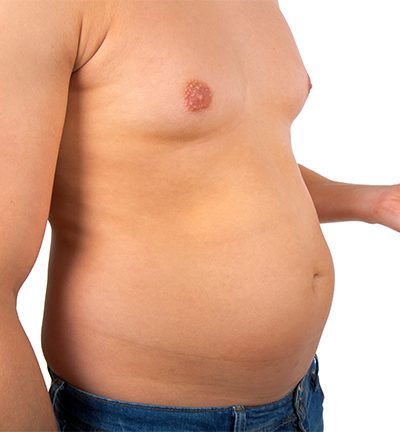
pseudo-gynecomastia

The first: Exercise?

One thing is for sure, “push ups” are not one of the treatments.

The glandular tissues in the breasts are by nature sensitive to hormonal changes. They grow and swell when there is a surge in sex hormones. And shrink when hormone levels are low. Which is why females develop breasts at puberty.

Though uncommon, some boys also develop swelling in the breasts usually around puberty, but which then spontaneously resolves. It may affect one or both sided of their chests. The name for the condition is gynecomastia, and it is probably the result of a temporary hormonal imbalance causing the breast tissue to be sensitized. No treatment is needed for this group of boys.

Second: Investigate and Treat hormonal disorders, if any.

A small percentage of these cases of pubertal gynecomastia continue to have a small amount of breast swelling into adulthood. In the great majority of these persistent cases, there is no underlying cause to be found. However, a small percentage of these cases are associated with a more serious underlying conditions where excessive female hormones are produced – including certain cancers. But these are extremely rare.

Quite commonly these days, gynecomastia is also associated with the abuse of anabolic steroids for body building purposes. In fact, they constitute the large majority of the cases we treat.

And then there is “pseudo-gynecomastia”. Whereas in gynecomastia, the breast’s glandular tissues are enlarged, in psedo-gynecosmastia only the surrounding fat tissue is excessive, which then gives rise to the appearance of breasts on a man’s chest.

“Pseudo” or “real” are quite easily distinguishable. When squeezed between your fingers, fat feels different from glandular tissue. Fat being softer to touch than glandular tissue. An ultrasound scan may also be useful to distinguish between the two.

Distinguishing between “pseudo” and “real” gynecosmastia is important because while pseudo-gynacomastia is mainly a body contouring issue and there are methods including liposuction which can help reduce it; “real-gynecomastia” may be a sign of a more serious underlying pathology. And it calls for clinical investigation into whether there are underlying medical conditions.

A series of tests (lab and X rays) should be able to rule out the more serious stuff. And the tests are not expensive. Referrals can be made if serious underlying conditions are detected.

Third: Liposuction or Excision for Men Boobs

In most of the cases, there will be nothing wrong elsewhere and then the gynecomastia becomes a purely cosmetic issue. The breast tissues can be surgically excised in a minor surgical procedure.

The commonest group of patients that present with male breasts are nowadays those whom had at some point in their lives abused anabolic steroids.
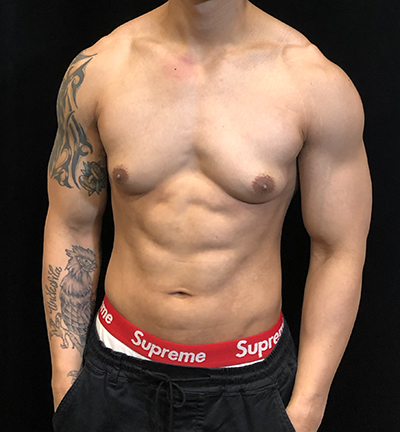
gynecomastia

The signs are very tell-tale. Firstly, these patients are bulkier in terms of muscle mass than an average male, they have rougher and more leathery skin than usual, and they have “bitched nipples” (this is body-building terminology for permanently erected nipples).

Treatment for this group of patients may involve combining a liposuction with a surgical excision, as they would have both swollen glands and accumulated fat after they abandoned the body building circuits.

There are of course medications that can help block the oestrogen sensitivity. Drugs like Clomiphene and Tamoxifen are inexpensive ones. They may not always work. So cosmetically speaking liposuction and or surgical excision is still the surer bet.


About our Doctors

Dr David Loh is the founder of David Loh Surgery located in Wheelock Place and Novena Medical Center. He is assisted by Dr Phoon Yi Shan, who is a senior partner in the aesthetic practice. Dr David Loh is accredited by MOH to perform liposuction. Dr David Loh is the President of the Society of Aesthetic Medicine.

Our doctors use a combination of liposuction and surgical excision to help our male patients achieve a better-looking chest. We will investigate for any underlying medical condition that may be causing the hormonal imbalance.
WhatsApp us at 9153 1503

Read more about Gynaecomastia Excision

Read more about Gynecomastia

Read More
Nanofat

5 things to know about Nanofat Grafting

Fat grafting is a long established technique in cosmetic surgery; probably for as long as liposuction has been available. And that’s since the later part of the 1980s.

What’s new is that we can now select the smallest particles of fat cells (Nanofat), and use them to erase lines and wrinkles, as well as to improve skin quality. Some researchers have referred to them as stem-cell-like fractions called Stromal Vascular Fraction (SVF) or Mesenchymal Stem Cells (MSCs).

1. WHAT IS NANOFAT GRAFTING?

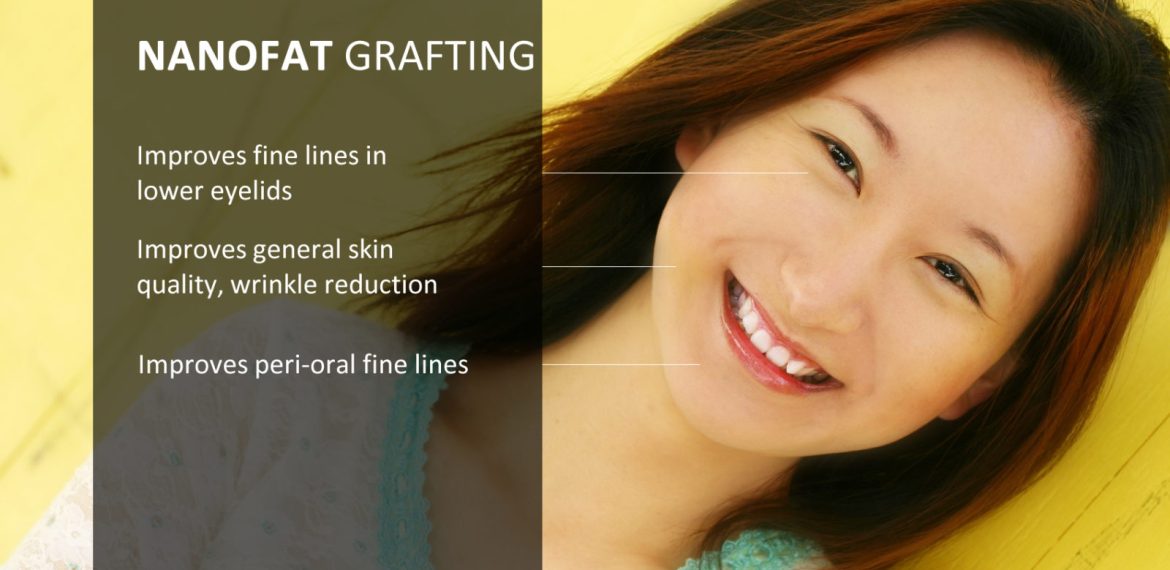
Nanofat injection is a method to reduce fine lines and wrinkles, or generally to improve skin quality in the face.

Nanofat is delivered like a filler injection except in this case the material used is autologous fat (one’s own fat cells).

Fat grafting (or fat transfers) are not exactly a new procedure. The procedure where grafted fat is used to volumize and lift the face, has been around for a long time. Of course, techniques and methods have improved over time. However, the advent of Nanofat represents a quantum leap in Fat Grafting methods. We are now able to treat even the fine lines under the eyes and around the mouth using Nanofat delivered with a very fine cannula.

Nanofats are actually the smallest particles of fat cells, which will survive best in a transplant scenario. The skin benefits are believed to be at least partially due to the stem-cells and growth factors in the Nanofat.

The ability to micronize fat cells down to very fine spheres has opened up many new possibilities, and as such the field of fat grafting has re-gained in popularity in the last few years.

2. WHAT IS NANOFAT USED FOR?

Nanofat can deliver skin quality improvements like the reduction of fine lines and wrinkles.

Recent studies have also shown that nanofat can improve the appearance of old scars (reference article – click here). (Updated in 2021 in The Plastic Reconstructive Journal: Adipose-derived stromal vascular fraction, or more commonly referred to as Nanofat, can improve skin quality via increased collagen production, and resist UV induced skin damage when injected into the dermis of the skin.

Used together with MilliFat and MicroFat, which provide structural support for the sagging face, we can reverse a host of the signs related to ageing. The only thing it does not treat is pigmentation. But it can even reverse skin damage due to sun (or UV) exposure.

Fat grafting is often used to enhance the effects of a threadlift or some non-surgical facelift like Ultherapy and Thermage.

3. WHAT IS THE FAT GRAFTING PROCEDURE LIKE?

The procedure involves harvesting fat from the abdomen or the inner thighs under local anaesthetic – essentially a mini-liposuction.

The fat is then cleaned, filtered and separated into different size cells – MilliFat, MicroFat or NanoFat. The larger fat cells are used to revolumize and lift the face, a kind of structural support, using a technique that Dr David Loh published. The technique has been commonly called the DL Lift.

The smallest of the fat cells are the Nanofat. They are used for the reduction of lines and wrinkles. Or for general skin quality improvements.

During the whole process from extraction, filtration to re-injection, the fat cells are completely free from environmental contamination (scientific jargon: closed system). We have a patented closed system for nanofat injections.

Post procedure, there will be some bruising and discomfort in the donor area (the area where fat was harvested in a mini-liposuction). This may take a few days to a week to recover. The overall discomfort is generally mild.

The face where the fat has been grafted will also be slighted swollen (about 20% bigger, I would say), and be slightly tender (sore to touch). Some bruising is to be expected, but again the overall recovery process is quite comfortable.

4. HOW LONG CAN THE GRAFTED FAT LAST?

A certain percentage of the transplanted fat will not take in the new environment and undergo apoptosis. Usually for the face, because of the rich blood supply, graft survival rates are quite high. You can expect somewhere in the region of 40%-60% grafted fat survival rates. So, we only need to over transplant by a little to achieve the desired outcomes.

After about one-month, whatever fat cells that remain will last forever. They will have been incorporated into the face and will last forever barring the ravages of time. In fact, they will expand and contract with extremes of weight fluctuations.

5. HOW DOES FAT GRAFTING PRICE COMPARE WITH DERMAL FILLERS?

When we do a fat grafting procedure, it is always a full face procedure. Meaning we treat the forehead, temples, cheeks and even the chin. And we harvest nanofat to treat the undereye and perioral areas too. The reason being that we want to maximize the areas treated because a mini-liposuction is involved each time. Multiple syringes of dermal fillers would be needed in order to treat similar areas. Maybe of the order of 8-12 syringes. At $1000 per syringe, you can imagine the cost even if we give discounts when multiple syringes are used. See your price list

Fat grafting (structural augmentation and nanofat grafting) costs $4,000 before GST. That’s it. And a proportion of the fat will stay for the long term.

The only “shortcoming” with fat grafting is that certain areas that need stronger structural support like the chin and the nose, harder HA fillers like Volux might still be better. In order to achieve the kind of projection needed for such areas.


Read more about Liposuction, Vaser Liposelection, Liposuction Not being a method of Weight Reduction, but instead Liposuction being more about a sense of proportion

And did you know we can correct over done fat transfers (fat grafting)?

WhatsApp us on +65 9153 1503 for more on fat grafting, nanofat grafting, and stromal vascular fractions (adipose derived stem cells). 

Read More
ultimate_guide_to_vaser_liposuction

Ultimate Guide to Vaser Liposuction

[vc_row][vc_column][vc_column_text]

Vaser Liposuction is also known as Vaser-assisted liposuction, or Vaser Liposelection.

[nz_dropcap type=”empty full” color=””]V[/nz_dropcap]aser is a liposuction procedure that uses high-frequency sound waves (ultrasound) to break up fat deposits before the fats are physically sucked out. This loosens up the fat pockets, which in turn reduces the effort to extract the fat cells. So what we can achieve with Vaser Liposuction is an effective liposuction (ie. large areas can be treated with less surgeon exhaustion), potentially less skin unevenness, and with generally less trauma.

[nz_gap height=”25″ /]

It is worth noting here that the best liposuction results depend on the the skill and experience of surgeon, and not so much on “what tools he uses”. Vaser Liposuction, Vaser HD or even other techniques of liposuction are not a weight reduction tools. Liposuction is a body-sculpting and contouring treatment that is best suited for small areas of disproportion like the saddle bags, the abdomen and love-handles or the breasts in men.

[nz_gap height=”25″ /]

[nz_gap height=”25″ /]

The Steps in a Vaser Liposuction Procedure
[nz_gap height=”25″ /]

  1. The first step during Vaser Liposuction is tumescent anaesthesia. This anaesthetic solution is infused into the fat layer just under the skin to “distend” it. The distended fat layer makes it easier to move the suction cannula through it. It also reduces bleeding and provides greater comfort after the whole liposuction procedure.[nz_gap height=”25″ /]
  2. The next step involves the use of an ultrasonic probe which is inserted into the fat layer to loosen up the fat. This step is particularly useful in areas where the fat is dense (tough) or if there is a lot of adhesions from previous liposuction or even with Paroxysmal Adipose Hyperplasia (PAH) following Coolsculpting.[nz_gap height=”25″ /]
  3. Then the suction. The end point of “suction” in any liposuction is deemed to have been reached when the curves flow smoothly and harmoniously. In Vaser HD (high-def Vaser), special cannulas are used to sculpt muscle shapes out of fat deposits.[nz_gap height=”25″ /]
  4. The recovery time depends on the extent of the areas treated. For the thighs, most of our vaser liposuction patients are up and about the next day. Bed rest is not necessary, but their movements might be a little slower because of the soreness. They might even be back in the gym the following week.[nz_gap height=”25″ /]

Where is Vaser Liposuction done?

[nz_gap height=”25″ /]

The Vaser liposuction procedure is performed in a Day Surgery OT with and anaesthetist. The amount that can be treated in a session really actually depends on the safe amounts of tumescent anaesthesia that can be injected in a session. And this is calculated based on the weight of the person.

What is Vaser HD?

[nz_gap height=”25″ /]

Vaser HD means we sculpt the patient’s layer of fat into muscle shapes. Or else we can also suck nearer to the skin so that the muscle shapes beneath are revealed.


[/vc_column_text][vc_single_image image=”7223″ img_size=”full” add_caption=”yes”][/vc_column][/vc_row]

Read More