Treat signs of aging using under eye dermal fillers
A couple of things happen as we age. The fat compartments under the eyes above the cheeks shrink (atrophy is the scientific term). Thus reducing support for the skin and muscles around the eyes. The bones around the eye sockets also remodel (change shape) which causes even greater loss of support for the overlying soft tissues. This sagging in the under eye area gives rise to the signs of aging. And dermal fillers are a great way to reduce the signs of under eye aging.
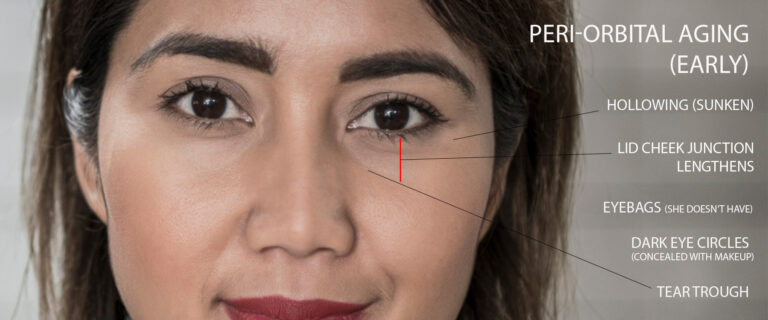
Under-eye area showing signs of aging
5 signs of under-eye-aging:
Hollowness or sunken under-eye area is the direct effect of the fat atrophy.
The lengthening of the lid cheek junction (above red line) which is due to the lack of support.
The tear-trough deformity, which is a groove under the eyebags. This is also due to the lack of support.
The Eyebags. These may be psuedo-eyebags caused by skin laxity rather than actual eyebags, which are caused by fat pad herniation.
Dark eye circles. Thin skin draping over muscle gives rise to the darker color. Only very rarely are dark eye circles the result of actual pigmentation on the skin.
The Treatment For Under-eye Aging
The treatment however is relatively simple. Dermal fillers when skillfully injected into the fat compartments in the under-eye area provides support and resolves most of the above problem features. The dermal filler is carefully placed using a cannula (a needle with a rounded tip) to minimize trauma. The dermal filler spreads evenly over the areas treated. Lumpiness is rare with the cannula technique of injection. Bruising can sometime occur even with a cannula but are usually quite minimal.
As for the crepey skin in the under eye area, the dermal fillers can help somewhat, but usually a bit of laser to tighten up the skin, and reduce the fine lines, and that’s all it takes to brighten up the look. The fractional CO2 laser is good, but has a bit of downtime. Otherwise, Sylfirm or Thermage eyes are not too bad too.
Watch Dr Davin Lim from Australia being treated by Dr David Loh while he was in Singapore. Under eye dermal filler injections.
The Liquid Facelift is a popular procedure in aesthetic clinics across Singapore. It is termed ‘liquid” because it involves using only B*tox (a liquid) and hyaluronic acid fillers (a gel) to create a lifting effect on the lower parts of the face. It is a non-surgical and involves very little recovery time. In fact, as a “facelift” achieved through injections only, it has also been popularly called a “non-surgical facelift” or “lunchtime makeover”.
Over the years, many experts have also described other variations of the Liquid Facelift, and they are all very good.
The are 3 important factors to consider when performing The Liquid Facelift.
The first is where to inject. Great masters of filler injections have proposed various depths of injection. Some for reasons of safety (deeply just above the periosteum), while others have target the “retaining ligaments” to build “struts”and “supports” for the sagging. Dr David Loh proposes that fillers be placed into fat compartments to mimic the state they were in before they underwent atrophy with age.
The second is when to inject. Understanding that fat pads will sequentially atrophy in the process of aging, might one not be able to pre-emptively inflate the fat pads to prevent sagging altogether? Hence the question about when to inject becomes quite important as we can prevent, rather than chase, signs of aging.
And the last consideration is how to inject. This is a cannula vs needle question that many expert injectors of dermal fillers have weighed in on. And the aesthetic medicine community is actually quite divided on which technique is better. Dr David Loh’s technique uses a cannula to accurately deliver fillers into the fat pads.
With there 3 considerations in mind, Dr David Loh popularized and has been teaching a particular form of the Liquid Facelift since 2015, and the technique has been named The DL Lift by many in his industry; DL being the initials for Dr David Loh who described it.
What is the underlying philosophy of The DL Lift?
In 2018, Dr David Loh and Dr Phoon Yi Shan, the partners the David Loh Surgery, described and published The DL Lift in The Prime International Journal of Aesthetic and Anti-Ageing Medicine, a medical industry journal, detailing the technique for other doctors.
One of the fundamental reasons why we sag when we age is because of sequential and progressive fat compartment shrinkage. Yes, fats in the face are compartmentalized and they are adjacent to each other. When one compartment shrinks, the tension in the whole structure we call the SMAS is weakened, and sagging happens.
However, the fat compartments shrink sequentially, some like the under-eye fat pads shrink as early as when we are in our late twenties. Hence hollowness and tired looking eyes can be seen in commonly in the thirties. Then the temple fat compartments shrink in the thirties, and the lateral cheek fat compartments shrink in the forties. This leads to the formation of the jowls in the fifties. This is a well-documented phenomenon that has been published in medical literature.
Doctors at David Loh Surgery have shown that by selectively restoring volume in certain fat compartments that have begun to atrophy, we can restore tension in that layer under the skin that supports the face.
“More importantly, if we already know when which fat compartment will atrophy in each stage of our lives, we can preemptively add volume to that compartment, so that facial sagging can be slowed down or even prevented altogether.”
This preventive anti-sagging proposition is a novel concept, because in real life most people would not approach a doctor to reverse aging until aging has occurred.
The DL Lift technique involves using cannulas to accurately deliver fillers (or autologous fat) into the specific fat pads that have either atrophied or are predicted to atrophy. This restores the tension within the SMAS and gives a mild facelift type effect. The whole procedure takes less than an hour and the results are instant.
There is usually little recovery time, only the occasional bruises and some swelling that might take a week to subside. The procedure can be used in conjunction with other treatment like Ultherapy, Thermage and Thread Lifts.
Dr David Loh founded David Loh Surgery in 2002 with the aim of helping his patients improve their appearance and self-image, and in the process enhance their confidence. The clinic only uses treatments that are scientifically proven to be safe and effective. The medical jargon for this is “evidence based”, and has remained a cornerstone of all treatments provided at David Loh Surgery.
Furthermore, these treatments usually involve little or no recovery-time. Treatments like b*tox and fillers, fat transfers and ultherapy are what Dr David Loh is better known for.
Dr David Loh and Dr Phoon Yi Shan have left their mark in the medical aesthetics industry through publications like the one above in The Prime Journal, as well as on matters relating to filler complications management. One of their papers was awarded a Best Paper (Gold) by the Plastic and Reconstructive Surgery journal in September 2019.
Dr David Loh is the President of The Society of Aesthetic Medicine in Singapore, which actively promotes safety, efficacy and standards of care among its members through regular teaching sessions, workshops and conferences.
In the age before Hyalase (or more accurately Hyaluronidase) became easily available, over injection of fillers was a nightmare most aesthetic doctors had to deal with pretty regularly. Luckily the fillers of that age didn’t last so long and most doctors weren’t so adventurous, sticking mostly to the nasolabial folds.
In that era (circa 2002-2005), some of us had to resort to using lasers and IPLs to dissolve the fillers, which of course didn’t work. We now know better and have stopped advocating lasers to “dissolve” fillers”. But the lesson learnt allows us to confidently use skin tightening devices like Ulthera together with fillers without the fear of destroying the fillers.
Now with hyaluronidase available, however, we can infinitely adjust fillers as long as they are made of hyaluronic acid. Too much and we will dissolve some of it away. Too little, we can inject some more. This gives us us accuracy and precision to venture into more hallowed areas like the tear trough and the marionette lines.
The hyaluronidase instantly dissolves the fillers in situ. It breaks Hyaluronic acid down into simple sugars that can easily be absorbed into the bloodstream or the lymphatic system. After several days when the hyaluronidase has been reabsorbed and any swelling has subsided, we can do the corrective adjustments for the areas as some of the surrounding will also be inevitably be affected.
Hyalase gave us the ability to infinitely adjust any filler treatments, gave us rise to the art of facial sculpting with fillers which we have termed the Liquid Facelift.
We all know about fillers into lines like the nasolabial folds. And we all know about fillers in the cheeks, the chin and the nose. Fillers were seldom employed in the upper third of the face in the forehead, eyebrow and temple area. At the 1st Malaysian-Singapore Conference of Aesthetic Medicine held in KL on 15 July 2012, Dr David Loh demonstrated the advanced techniques of upper face fillers and brow injections produce a stronger forehead. This is particularly useful for those with eyes that protrude producing a groove in the upper eyelids. It is also useful for Asians men with very flat foreheads to get stronger (hooded brow) features. Or even Asian girls who want to make their features a little more Caucasian-like (less flat). Upper Face Fillers is an advanced technique which should only be attempted by experienced injectors.
NB: Dr David Loh is not a fan of using fillers to fill lines. He feels that injecting fillers in the skin (in the dermis) can sometimes leave lumpiness obvious under certain lighting. No matter how refined the fillers are and how experienced the injector is. Besides a lot of these lines like the crow’s feet and the glabellar frown lines are better off treated with B*tox. Dr David Loh advocates using fillers to sculpt the face and to soften features by altering volume and providing supports for the skin so that it does not sag.
Dr David Loh started his aesthetic clinic in 2002 when the field Aesthetic Medicine was still in its infancy. He is now a well known international trainer for advanced B*tox and Filler techniques. He is on the faculty of the Allergan Academy and is the President of The Society of Aesthetic Medicine.